
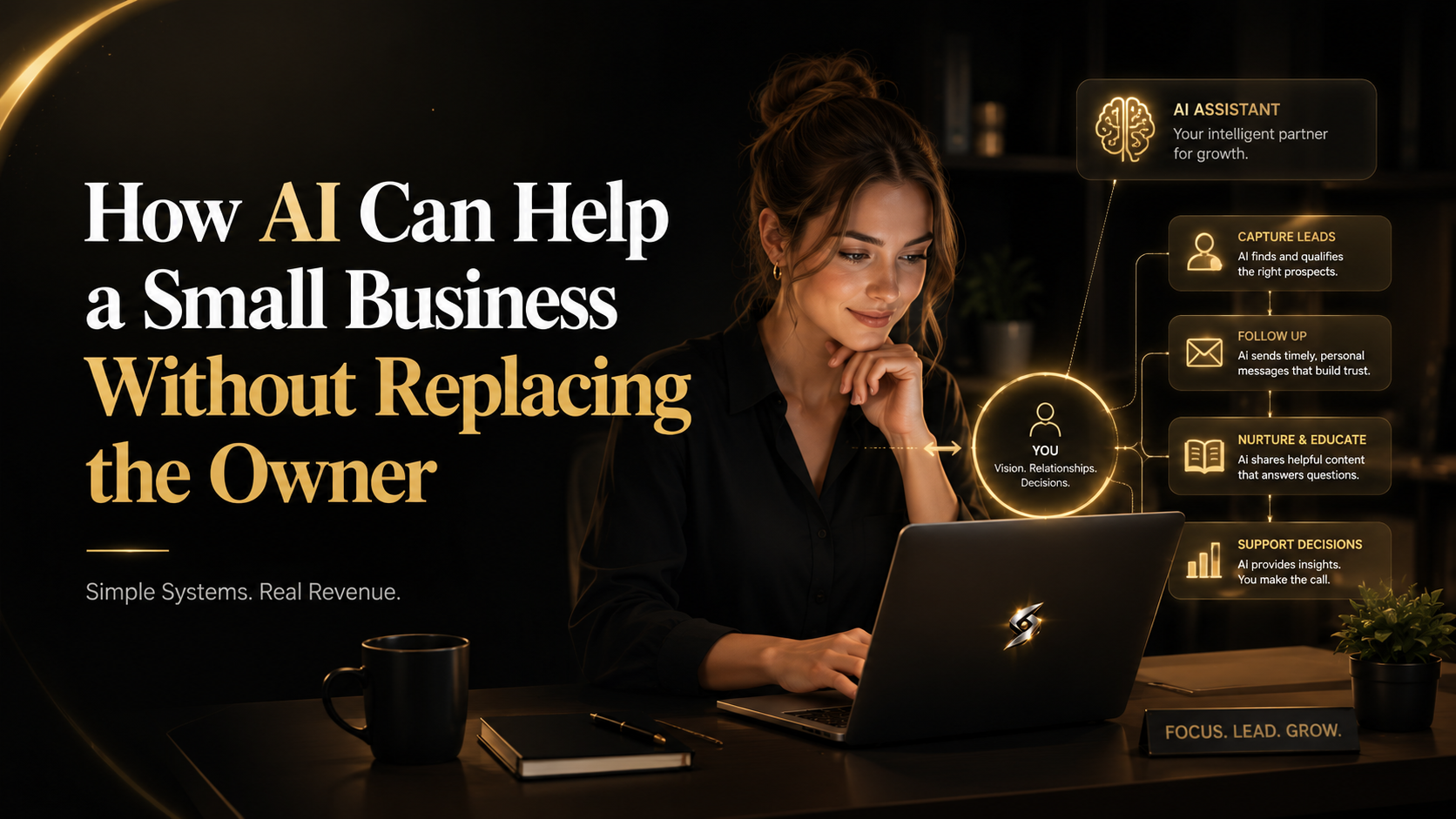
AI can help a small business by handling repetitive thinking work, organizing ideas, creating first drafts, answering common questions, and helping the owner move faster without giving up control of the business.
The important part is this: AI should not replace the owner’s judgment. It should support it.
A small business owner still knows the customers, the service, the local market, the tone, the promises, and the real-world details better than any tool. AI becomes useful when it helps the owner turn that knowledge into better systems.
AI Is Not the Business
One of the biggest mistakes people make with AI is thinking it is the whole solution.
It is not.
AI is not your reputation. It is not your customer service. It is not your offer. It is not your follow-up strategy. It is not your relationship with the people you serve.
AI is a helper inside the system.
For a small business, that can be a big deal. Most owners are already doing too much. They are answering messages, creating posts, following up with leads, handling customers, making decisions, and trying to keep the business moving. AI can help reduce some of that pressure when it is used with a clear purpose.
Where AI Helps The Most
AI works best when it is given a specific job.
Instead of asking, “How can AI run my business?” a better question is, “What simple task is taking too much time?”
Here are practical ways AI can help a small business:
- Create first drafts of social media posts.
- Write email follow-up ideas.
- Turn customer questions into FAQ content.
- Summarize notes from calls or meetings.
- Help organize offers, services, and product descriptions.
- Create simple training outlines.
- Write video scripts for short business videos.
- Help explain a product or service in plain English.
- Build checklists for repeatable business tasks.
None of those jobs require AI to replace the owner. They simply help the owner move faster.
The Real Power Is In The System
AI becomes much more useful when it is connected to a business system.
For example, writing one social media post is helpful. But building a weekly content system is better.
Writing one follow-up email is helpful. But building a follow-up path for new leads is better.
Answering one customer question is helpful. But turning common questions into a Learn Center, FAQ, video, or customer guide is better.
That is where AI starts to matter for real businesses. It helps turn scattered ideas into repeatable systems.
A Simple Example
Imagine a local service business gets the same questions every week:
- How much does it cost?
- How long does it take?
- What happens after I request a quote?
- Do I need to book an appointment?
- What areas do you serve?
The owner already knows the answers. But the answers may be scattered across text messages, phone calls, emails, and memory.
AI can help turn those answers into useful business assets:
- A website FAQ section.
- A follow-up email.
- A short explainer video script.
- A customer checklist.
- A social media post.
- A training note for staff.
That is not replacing the owner. That is helping the owner package what they already know.
AI Should Make The Next Step Clearer
One of the best ways to use AI is to make the customer journey easier to understand.
When someone visits a website, scans a QR code, clicks a link, reads an offer, or asks a question, they should know what to do next.
AI can help a business write clearer calls to action, cleaner explanations, better follow-up messages, and more useful customer education.
But the business still needs a system.
The question is not just, “Can AI write this?”
The better question is, “Where does this fit in the customer journey?”
Good Uses Of AI For Small Businesses
Here are some strong, practical uses of AI:
- Turning one idea into multiple content pieces.
- Creating a first draft of a customer email.
- Writing simple explanations for products or services.
- Creating a list of questions customers may ask.
- Helping plan a follow-up sequence.
- Creating training notes for a team.
- Improving clarity on website pages.
- Brainstorming campaign ideas.
The owner should still review everything. AI can make mistakes, misunderstand tone, or leave out important real-world details. The business owner’s judgment is still the final filter.
Bad Uses Of AI For Small Businesses
AI becomes risky when it is used without oversight.
Small businesses should be careful with:
- Publishing AI-written content without reviewing it.
- Letting AI make promises the business cannot fulfill.
- Using AI to send cold or unwanted messages.
- Relying on AI for legal, medical, financial, or compliance advice without a qualified professional.
- Creating generic content that does not sound like the business.
- Trying to automate relationships that should remain personal.
AI should make communication clearer, not colder.
Where Struvarion Fits
Struvarion is built around a simple idea: businesses need systems that connect attention, leads, follow-up, and customer journeys.
AI can support that system by helping create better content, clearer messages, stronger follow-up, and easier education.
But AI works best when it has a place to go.
A useful AI-assisted business system might look like this:
- A customer scans a QR code.
- They land on a simple page with a clear next step.
- They receive helpful follow-up if they gave permission.
- They can read an article, watch a video, book a time, or contact the business.
- The business owner uses AI to keep the content and communication clear.
That is the difference between using AI as a toy and using AI as part of a real business system.
The Bottom Line
AI can help small businesses move faster, communicate better, and organize ideas more clearly.
But it should not replace the business owner.
The owner still brings the judgment, experience, customer knowledge, and real-world promise. AI simply helps turn that knowledge into useful content, follow-up, and systems.
The best use of AI is not to remove the human side of the business.
The best use of AI is to help the human side show up more clearly, more consistently, and more efficiently.
Next Step
If you want to understand how AI fits into the bigger picture, start with the Struvarion Learn Center and look at how simple systems connect leads, follow-up, QR campaigns, email, SMS, booking, and customer journeys.
Visit the Struvarion Learn Center
Keep learning the system.
Struvarion is built around simple business systems: attention, lead capture, follow-up, customer journeys, training, offers, and practical growth.
Explore Training